

Blended Learning
🔒 For SMU Instructors
Access the implementation guidelines, course design toolkit and FAQs or submit a Blended Learning proposal.
Blended Learning (BL) at SMU
At SMU, Blended Learning (BL) is an institutional pedagogical approach that enhances our distinctive interactive, seminar style teaching. It goes beyond the use of technology by intentionally integrating face to face and online learning to deepen engagement and support active, inquiry driven learning.
Face to face sessions remain the cornerstone of the SMU experience, enabling rich dialogue, immediate feedback, and dynamic peer interaction. Online components complement this by offering flexibility, supporting self directed learning, and expanding access to diverse resources.
Adopted across the university, BL extends learning beyond the classroom while strengthening, not replacing, our interactive pedagogy. The result is a more connected, flexible, and impactful learning experience that prepares students to thrive in a dynamic world.
In designing a blended learning experience, instructors must decide which instructional modes best support the learning they intend to create. The Community of Inquiry (COI) framework helps guide these decisions by clarifying the types of teaching, social, and cognitive engagement needed, allowing instructors to select and design modalities that align with those goals.
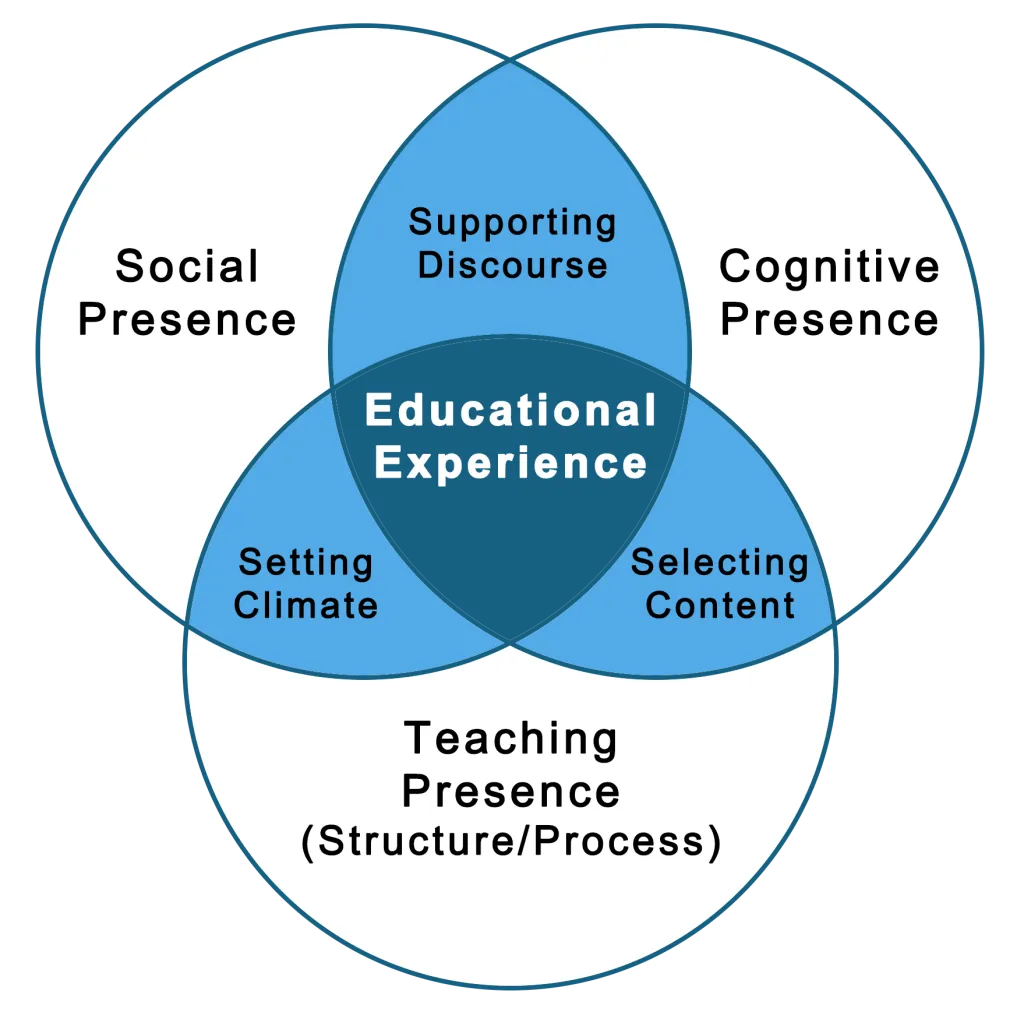
The Community of Inquiry (COI) framework[1]
Community of Inquiry (COI) informs the methodology to deliver successful online learning, by building a community of learners.
- Teaching Presence:
Instructor designs, facilitates, and guides learning; reinforces concepts, addresses misconceptions, and supports engagement. - Social Presence:
Students build connections and communicate openly in a safe environment; fosters interaction and participation. - Cognitive Presence:
Students construct meaning through reflection, discussion, and problem-solving; apply ideas and formulate solutions.
Once the forms of presence needed for meaningful learning are clear, instructors can begin shaping how these experiences unfold over time.
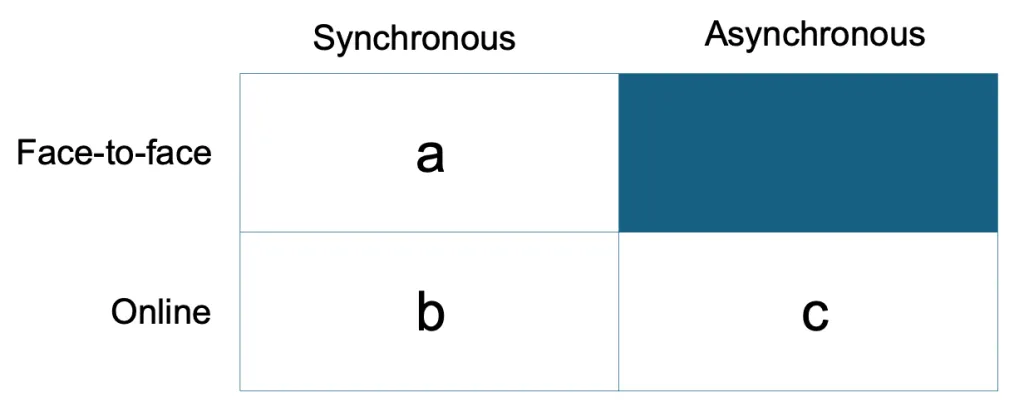
BL uses a mix of face-to-face, synchronous online, and asynchronous online activities to support student engagement and learning.
Mode a represents face-to-face, synchronous learning that takes place in real time on campus.
Mode b captures online synchronous activities, such as live guest talks, virtual collaboration with overseas partners, and real-time class meetings or group consultations.
Mode c represents online asynchronous learning, which supports flexible, self-paced engagement through interactive videos, recorded lectures, guest interviews, animations, discussion forums (e.g., eLearn, Piazza), and collaborative digital tools like Google Apps, Padlet, MIRO, and mind-mapping platforms.
Structure of a 12-week Term
The following examples illustrate how a three-hour weekly lesson can be structured across a 12-week term using different blends of face-to-face, synchronous, and asynchronous modes.
Scenario 1 shows a week-by-week alternation between face-to-face (a) and online components (b), and online asynchronous (c) learning.
In this model, instructors allocate full weeks to either in-person sessions or online learning blocks, creating four dedicated online slots across the term. This approach allows deeper engagement within each mode while still maintaining a balanced blend over the semester.

Scenario 2 depicts a within-week blend, where each week combines shorter face-to-face and online segments.
For example, Week 1 includes 1 hour of online learning followed by 2 hours in person, while subsequent weeks vary the sequence and duration. This model offers greater flexibility and supports continuous interaction across both modes every week.

Together, these three modes form the core building blocks from which blended learning experiences are designed. By exploring different combinations, SMU instructors can tailor their teaching to student needs and create more personalised, impactful learning experiences.
Benefits to Student Learning Outcomes
The online components of blended learning would allow learners to have better control over:
| Space | Learning is not restricted to the seminar rooms; |
|---|---|
| Time | Learning is not restricted to formal contact hours; |
| Pace | Learning is not restricted to the pace set by instructors. Students have the flexibility of setting a schedule to accommodate their needs. |
| Path | Learning may not restricted to the sequence of learning and content designed by instructors |
Students have the flexibility of setting a schedule to accommodate their needs. Students residing outside Singapore can participate in courses. Online synchronous modalities more easily facilitates exchanges with international and local guest speakers. Students can collaborate with project sponsors and overseas group mates to leverage on their different perspectives and viewpoints.
Research studies have found that Blended Learning approaches help students:
- Develop self-directed learning strategies as they go through course materials at their own pace
- Review and reflect
- Be better prepared for class to achieve intended learning outcomes.
For instance, a course is recommended to have between one-third and one half of its time online (with a focus on interactions), with students performing significantly better than students in other course designs that have less time online. [2]
Learn more about the impact of blended learning at SMU.
i.Connect (Industry Connect)
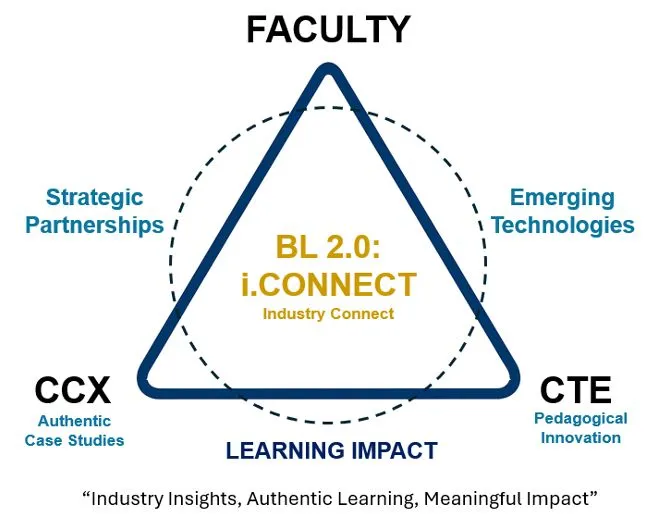
Building on our strong foundation of institution-wide BL implementation, we are advancing to the next phase of implementation through the i.Connect initiative. This initiative aims to advance teaching innovation and enhancing learning experiences by enabling students to apply knowledge in real-world contexts while further enriching engagement and learning outcomes.
Instructors are supported in integrating authentic industry perspectives and AI-enabled learning experiences into their courses. i.Connect also encourages applied, relevant learning through interactive scenario-based learning activities enabled by AI simulations.
Contact CTE if you are keen to find out more.
References
- Garrison, D. R., & Vaughan, N. (2008). Blended learning in higher education: framework, principles, and guidelines. San Francisco: Jossey-Bass.
- Owston, R., & York, D. N. (2018). The nagging question when designing blended courses: Does the proportion of time devoted to online activities matter?The Internet and Higher Education, 36, 22–32. https://doi.org/10.1016/j.iheduc.2017.09.001