
Our Teaching Approaches
Teaching and Learning at SMU
At SMU, we design learning to be personalised, interactive, and grounded in real-world experience.
Students engage in learning that:
adapts to their needs and interests
involves active participation and collaboration
connects ideas to practical contexts and applications
These approaches are supported by the thoughtful use of digital tools. Technology is used not for its own sake, but to enhance how students learn—enabling deeper personalisation, richer interaction, and more authentic engagement with real-world problems.
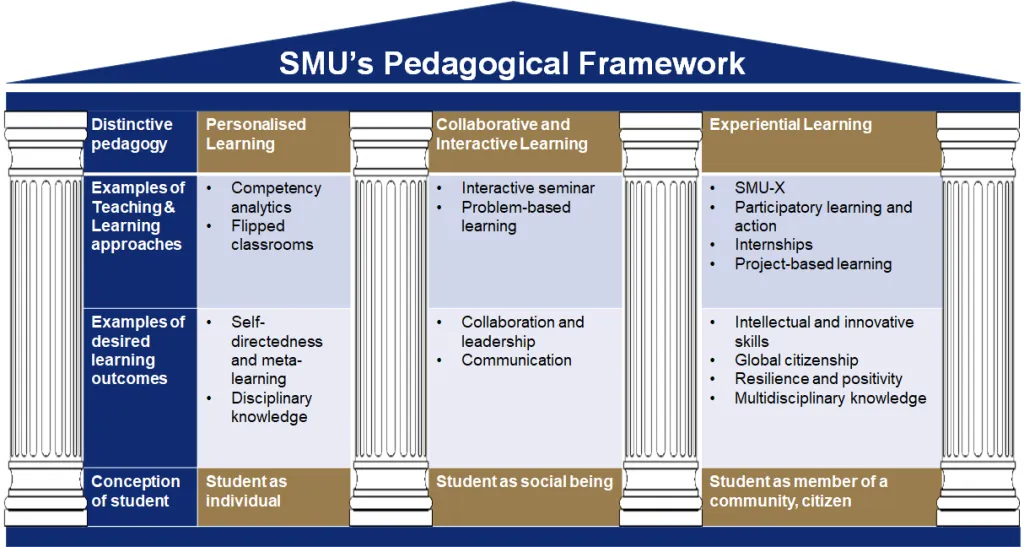
Personalised learning recognises that students differ in their learning needs, preferences, interests, and pace of progress. Teaching approaches are designed to provide targeted support and individualised attention.
Examples include flipped classrooms and the use of adaptive digital learning tools that respond to students’ learning trajectories.
Collaborative and interactive learning emphasises learning through dialogue, exchange, and collective inquiry. Teaching approaches create structured opportunities for students to interact, discuss, and debate with peers.
Examples include interactive seminars and problem-based learning.
Experiential learning connects academic learning with real-world practice and social contexts.
Teaching approaches empower students to contribute meaningfully to their communities through experiences such as SMU-X, participatory learning and action, internships, and project-based learning.
Blended Learning
At SMU, blended learning brings together the strengths of in-person and online learning to support active, engaging, and flexible learning experiences.
In-person sessions enable discussion, collaboration, and immediate interaction. Online components provide space for reflection, self-paced learning, and access to a wider range of resources.
Designed together, these modes complement one another, supporting deeper learning and more meaningful participation.
Blended learning is therefore not simply a mix of formats. It is an intentional approach to designing learning, where each mode is used purposefully to support how students engage, learn, and apply their knowledge.
Case-based learning
At SMU, the case method is used to bring real-world situations into the classroom, enabling students to analyse complex scenarios, make decisions, and learn from different perspectives.
Students engage with cases that reflect real organisational and societal challenges. Through discussion, they examine evidence, consider alternatives, and apply concepts to situations where there are no straightforward answers.
Instructors guide this process by framing key questions, challenging assumptions, and facilitating dialogue. The focus is not on arriving at a single “correct” solution, but on developing the ability to reason, justify decisions, and engage thoughtfully with others.
This approach helps students learn how to apply theory in practice, navigate ambiguity, and respond to the kinds of problems they are likely to encounter beyond the classroom.
SMU-X Curriculum
SMU-X brings real-world projects into the curriculum, enabling students to apply their disciplinary knowledge to complex, open-ended challenges.
Students work on issues drawn from industry, organisations, and communities, often in interdisciplinary teams. They engage with real stakeholders, navigate competing perspectives, and develop solutions in contexts where problems are not clearly defined.
Through this process, students learn to integrate knowledge, exercise judgement, and respond to practical constraints. In doing so they develop capabilities that are essential for professional and societal contexts.
SMU-X courses also create opportunities for meaningful engagement with external partners, allowing students to build connections while working on authentic projects.
SMU-X Curriculum
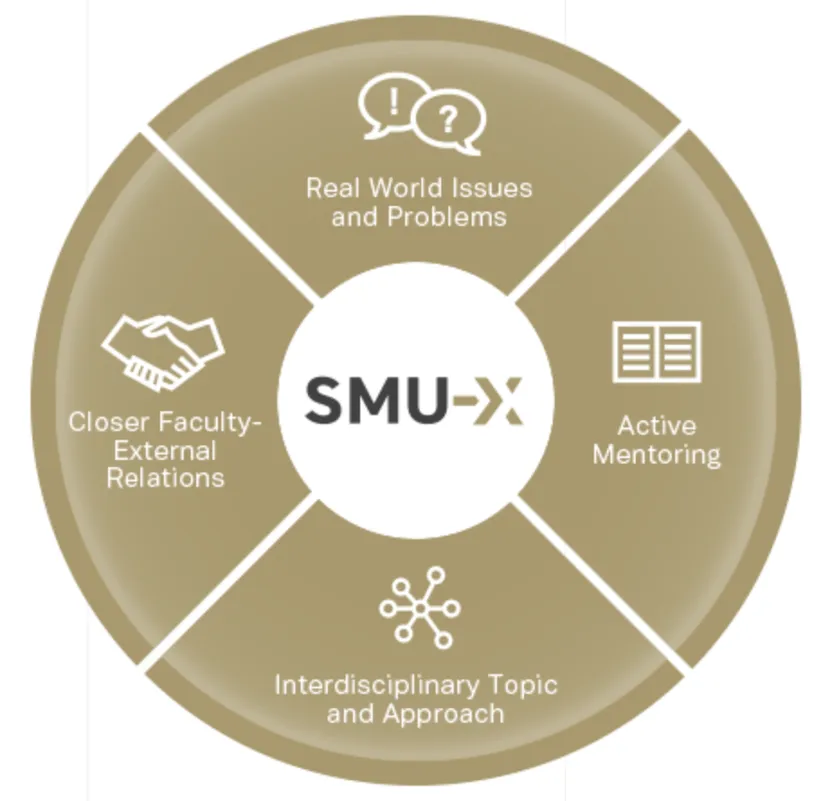
SMU-X brings real-world projects into the curriculum, enabling students to apply their disciplinary knowledge to complex, open-ended challenges.
Students work on issues drawn from industry, organisations, and communities, often in interdisciplinary teams. They engage with real stakeholders, navigate competing perspectives, and develop solutions in contexts where problems are not clearly defined.
Through this process, students learn to integrate knowledge, exercise judgement, and respond to practical constraints. In doing so they develop capabilities that are essential for professional and societal contexts.
SMU-X courses also create opportunities for meaningful engagement with external partners, allowing students to build connections while working on authentic projects.