The unauthorised use of generative AI tools is considered cheating - a violation of the SMU Code of Academic Integrity - and will be dealt with accordingly. Please refer to the Faculty Handbook for Academic Violations for more information (log in required). Penalties will align with the University's established practices for cheating.
Protocol for reviewing suspected cases of unauthorised use of generative AI tools: The DRIVE Approach
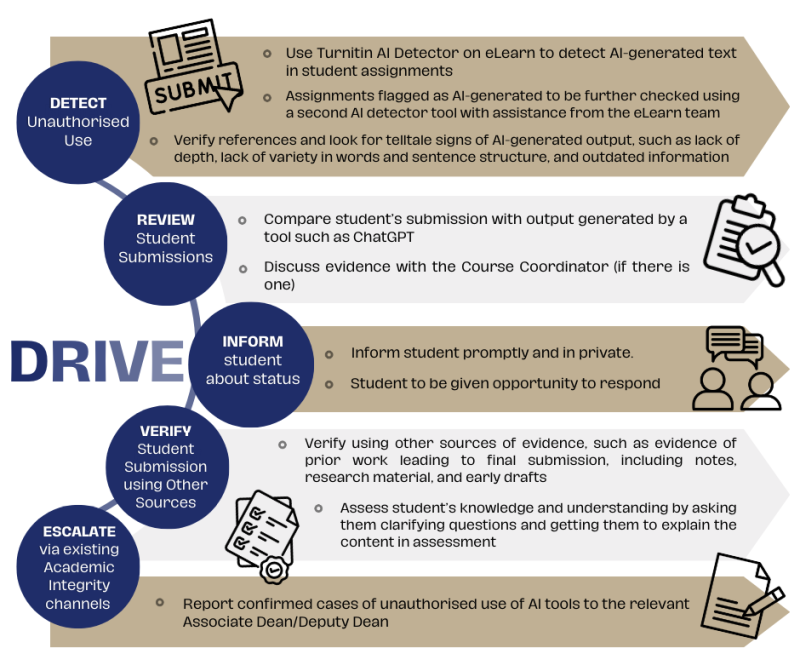
The following section outlines the protocol SMU instructors should follow in cases where unauthorised use of generative AI tools in assessment is suspected. The protocol is named the DRIVE approach, which is an acronym for:
D : Detect unauthorised use R : Review student submissions I : Inform student of status V : Verify using other sources E : Escalate via usual academic integrity channels
Details of the DRIVE Approach
Steps
Remarks
DETECT unauthorised use
Descriptor: Instructors apply AI detection tools to identify assignments with AI-generated content.
Details: Instructors submit student assignments to Turnitin AI Detection function. Enable Similarity Report” in your Assignment Setting - Evaluation and Feedback, to detect AI-generated text in student assignments.
Assignments flagged as AI-generated (> 20%) should be further checked using a second AI detector tool, such as GPTZero or Originality.AI. IITS' eLearn team will assist in conducting these checks, using the appropriate licences for these tools.
If the second detection tool produces a similar output and parts in the submission highlighted by Turnitin are also flagged by the second detection tool, further investigation should be carried out.
If second detection tool produces a different output, instructors have the discretion to use another tool, investigate further or give student the benefit of doubt.
Instructors may look out for the following features:
Repetition of words and phrases AI-generated text might repeat the same keywords and phrases with little variation.
Lack of depth Current versions of generative AI tools generally lack depth and cannot go beyond basic facts to truly analyze a topic and develop unique insight. AI-generated text might read more robotic and prescriptive than creative and have a generic tone.
Inaccurate and outdated information AI-generated output can be incorrect or unrelated to true facts. In addition, information can be outdated, depending on the cut-off date for information used to train the tool. For example, ChatGPT-3.5 is based on information available before September 2021.
Format and structure AI-generated output follows the same sentence structure as human output, but sentences tend to be shorter and lack the complexity, creativity, and varied sentence structure that humans produce. Content can be streamlined and uniform with little variation. Human-written text is also more likely to have typos and use informal and casual language.
REVIEW student submissions
Descriptor: Instructors review identified assignments with AI-generated content in greater detail.
Details: Review the AI detection tool report and compare student’s paper with the copied source(s).
Instructors may also generate an answer using an AI tool like ChatGPT and compare it to the student’s submission for similarities.
If available, compare the student's assignment with previous submissions.
Proactively conduct random checks on content and cross-checking references with websites like ‘Google Scholar’ and SMU Libraries’ databases.
Consult the Course Coordinator, if there is one, to go through submissions together.
INFORM student about status
Descriptor: Instructors communicate with students about the current situation and allow them to respond.
Details: Inform the student promptly and in private. Do offer them an opportunity to explain their position.
Guiding question:
'The output from the AI-detection tools suggests that some of your work was AI-generated. I have also independently checked additional examples of AI-generated responses. Are you able to explain why your detection tool output score is so high?'
VERIFY Student Submission using Other Sources
Descriptor: Instructors consult further sources of evidence, including those provided by students.
Details: Meet with the student and let him/her know your specific concerns and allow the student to run through evidence of prior work done.
Require the student to produce evidence of prior work done leading to final submission. Evidence includes notes, research materials, outlines, and drafts.
For submissions that test computational skills, such as financial accounting calculations or coding, ask the student to show workings and explain the steps.
ESCALATE via existing academic integrity channels
Descriptor: Instructors report confirmed cases of unauthorised use.
Details: Report the incident to the representative of your school (Deputy Dean or an Associate Dean). Follow established procedures for violations of the Code of Academic Conduct.