

Self-paced Learning Object

Pedagogy Alignment:
Personalised Learning
Faculty Lead(s):
CTE (Project Owner)
Tool Description
What is Adaptive Digital Learning?
Every student brings to a course his/her own level of aptitude and prior knowledge. In many classrooms, the instructors strive to adjust their instructional strategies to individual students and their learning styles. However, this is time-consuming and challenging, as each student learns at a different pace in practice.
Advances in adaptive learning technologies have now made it possible to personalise the learning experience for each individual student - targeting improvements in weaker areas, helping with knowledge retention and providing feedback that is “just in time, just enough, and just for me.” Adaptive digital learning takes into account current student performance, and adapts accordingly to support, and maximise learning. By design, adaptive digital tools respond to a student's interactions in real-time by automatically providing personalised instruction based on individual student abilities and learning progression.” (Basitere and Ivala, 2017; McGraw-Hill Education Group, 2014).
Using such adaptive learning technologies, instructors can more effectively “flip” the classroom, as they can better check their student's preparedness before engaging in more advanced instructional methods for deeper learning in the classroom (e.g. application of theory in case studies, advanced group exercises, projects, discussions, debates, presentations, etc.).
Many adaptive learning platforms also provide the instructor with feedback on which materials students are struggling with, allowing him or her to adapt the instruction based on the class’ progress. The promise of the technology is that, by ensuring sufficient mastery level for different topics, it allows the instructor to spend more time on active, constructive and interactive learning tasks to achieve higher-level learning objectives.
Evidence in support of adaptive digital learning
A literature review identified a limited number of experimental studies in which control groups were compared with treatment groups that used e-textbooks with adaptive learning features. Gearhart (2016), for example, found that undergraduate students in the treatment group achieved higher scores on textbook-related exam questions than those in the control group in an Interpersonal Communication course. In another study conducted by independent research firms commissioned by Cengage (2015), psychology students in the treatment group using Cengage’s MindTap platform performed about one-third of a standard deviation (Cohen’s d = 0.33) better than students in the control group not using MindTap.
Other studies, which did not use control groups, generally examined whether a student’s use of the e-textbook supplemented with adaptive learning features correlated with his or her exam grades (Gurung, 2015; Hegeman, 2015). The studies indicate (some of them controlling for overall GPA) that generally, higher use by students was associated with higher course grades.
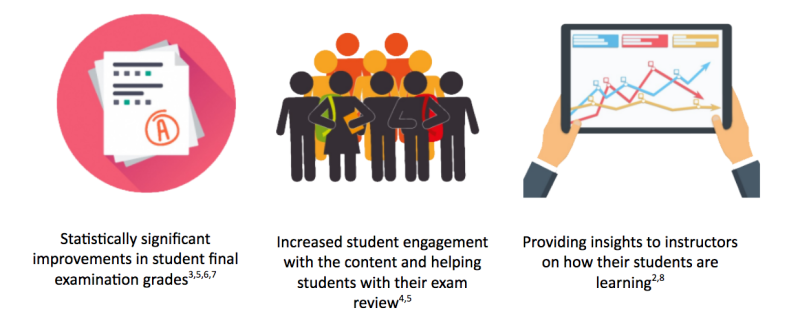
Adaptive digital learning also leads to increases in course pass rate (Pearson Education 2018; Broadway Analytics Inc, 2014; McGraw-Hill Education Group, 2014). The analytics reports in the adaptive learning platforms inform instructors of students falling behind to allow for early intervention.
Some studies also reported instructors’ and students’ perceptions of using them. In surveys and focus group interviews, students expressed higher levels of engagement with the course content. They also reported that the e-textbook supplemented with adaptive learning features helped them with the exam review (Gearhart, 2016; Griff & Matter, 2013). Instructors, on their side, found that they were able to gain meaningful insights on how their students were learning through the “analytics dashboards” (Broadway Analytics Inc, 2014; McGraw-Hill Education Group, 2014).
At the same time, some students in these studies reported that working on the practice questions and quizzes in such e-textbooks, took up more time than what they wanted to spend, citing lack of time and motivation, and forgetting as reasons for limiting their completion on the online practice questions and quizzes (Gearhart, 2016; Griff & Matter, 2013; Gurung, 2015). So, while current research findings require a nuanced assessment, we expect the impact on student learning to become stronger as the technology improves with more high-quality textbooks being converted to include well-designed and proven adaptive learning features.
It has to be noted that, while most of the studies are published by academics in peer-reviewed journals, some were commissioned by the educational publishers and conducted by independent research firms and not all of those were peer-reviewed (Pearson Education, 2018;, Cengage, 2015; Broadway Analytics, 2014).
Teaching Strategy
Adaptive digital learning in practice at SMU
At SMU, several faculty members have experimented with using adaptive digital tools for teaching to collect real-time data that provides insights on what and how their students are learning.
Students taking different courses in subject areas such as Economics, Statistics, Strategy, Finance and Organisational Behaviour and Human Resources (OBHR) have been supported in their learning with adaptive courseware offered by educational publishers. In measuring students’ perceptions on their experiences with the use of such adaptive digital tools, CTE collaborated with faculty members and administered surveys to collect feedback from students. Some students reported that clearer instructions could be given to facilitate their navigation of the educational publishers’ platform and suggested having more questions of higher difficulty levels (beyond comprehension and recall) included as part of the online quizzes. Technical issues such as taking a long time to load the e-textbooks, and the incompatibility of the e-textbooks on a certain mobile operating system were also shared by students. Nonetheless, the analyses of the findings were generally positive:
| 88% of Economics students reported improved comprehension of the course | 85% of Strategy students were able to make meaningful connections between the resource and the concepts taught in the lectures |
| 87% of Finance students would recommend the adaptive digital tool to their peers | 84% of OBHR students found the timely feedback useful for their learning |
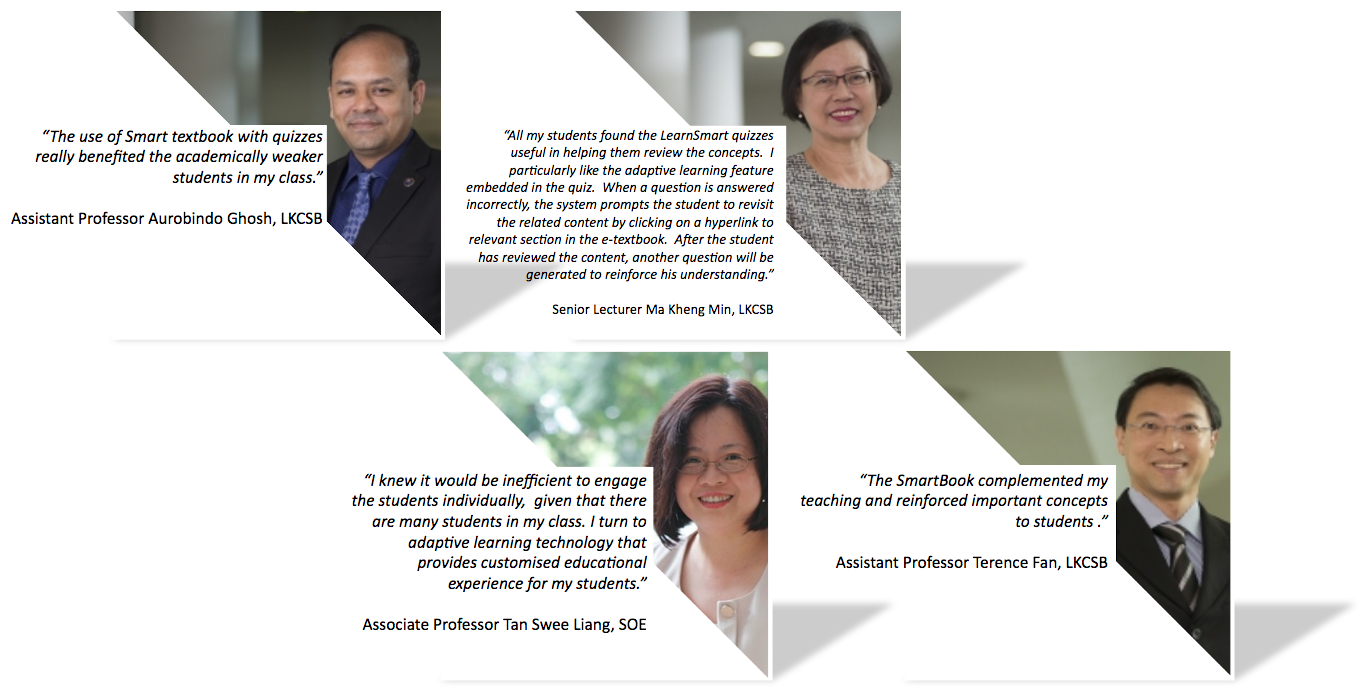
Faculty members’ testimonials:
Recommendations
Adaptive digital learning is a technology involving large investments by a significant number of established and new companies. A conclusive meta-analysis about its impact on learning outcomes is not yet available. Given the potential for economies of scale, the long-term impact on how education will be designed and delivered is not easy to predict. That said, there appears to be the potential for improved learning outcomes so it will be useful for SMU and SMU instructors to collaborate on integrating this technology.
Based on reviewed evidence and experience so far, CTE would like to offer the following observations and recommendations.
Our review of independent, peer-reviewed studies and audited research reports indicated that adaptive digital learning is associated with positive results in the following courses:
- Introductory Accounting (McGraw-Hill Education Group, 2014),
- Algebra (Hegeman, 2015),
- Anatomy and Physiology (Broadway Analytics Inc, 2014; Griff & Matter, 2013),
- Business (Broadway Analytics Inc, 2014),
- Physics (Basitere, 2015),
- Psychology (Gurung, 2015; McGraw-Hill Education Group, 2014), and
- Statistics (Pearson Education, 2018).
These courses seem to be “basic” or “technical” in nature. There is a sense that, currently, adaptive learning can be implemented successfully when the course content is mature, stable, well-defined, codifiable, etc. It might be harder to find good adaptive learning textbooks for electives or advanced courses.
- Electronic textbooks with adaptive learning features appear to be good at transferring (and testing) basic aspects of knowledge. This capability appears to benefit students who might otherwise struggle with the course and it can raise the bottom tail of students’ understanding, especially since the technology provides fairly detailed and real-time views of students’ learning. The types of learning objectives that can be achieved and tested by current technology is limited though (but evolving). Therefore, the instructor needs to develop a clear view about where the value of the e-textbook ends and where his or her value as an SMU instructor starts. This is only possible if the instructor is highly familiar with the e-textbook and the adaptive learning features, which may take more time than what instructors are used to spending with hard-copy textbooks.
- The amount of work needed to develop a consistently high-quality adaptive learning textbook is substantial. The actual quality of available e-textbooks clearly varies, and it is important for instructors to verify the quality of the e-textbooks they adopt.
- Based on our review of the aforementioned studies, we identified the following key success factors for the adoption of e-textbooks with adaptive learning features:
- Alignment and integration - choose the e-textbook carefully to closely match your course learning objectives; integrate the e-textbooks as part of the course instructional activities where students complete homework assignments to supplement in-class lectures.
- Learning/task value for students - count completion of responses on homework assignments/quizzes in the adaptive learning platforms as a part of the participation grade/extra course credit.
- Immediate, corrective feedback - reinforce the immediate feedback provided to students in the platforms by checking the analytics dashboards of students’ progress and by adjusting teaching accordingly. This increases students’ perceived value of the homework assignments/quizzes in the adaptive learning platforms.
Interested in adopting this tool for your course?
Adopting a textbook with adaptive learning features may involve redesigning one’s course. Besides pedagogical assistance from CTE on course redesign, instructors and students will also receive technical training and support from the educational publishers.
Given the voluminous selection of textbooks with adaptive learning features to choose from, CTE and SMU Libraries are maintaining a curated list of textbooks with adaptive learning features that could be worth exploring by SMU instructors. The criteria used for being on the list are: earlier non-adaptive versions of the textbook have been used at SMU before and/or the e-textbook is being used at other reputable institutions.
An overview of the adaptive digital learning textbooks and the curated list of textbooks is available from CTE upon request.
For instructors who have not been funded by CTE for using textbooks with adaptive learning features, apply for CTE’s TEL Funding and evaluation study. Available funds will be allocated based on the expected value of what can be learned from the evaluation study in which the support of the instructor is critical.
- CTE will collaborate with you on an experimental study to evaluate the impact of the adaptive digital tool on your students’ learning.
- CTE will provide funding support for 1 academic term, capped at 4 sections.
- CTE will also provide support in terms of pedagogical consultation, and vendor management.
Please contact CTE if you are keen to explore using textbooks with adaptive learning features for your teaching no later than 4 months before the commencement of your course.
