

Moderator
Themin Suwardy
Associate Provost (PGP Education)
Office of Postgraduate Professional Programmes
Associate Professor of Accounting (Practice)
School of Accountancy
Panellists
Mandy Tham
Associate Professor of Finance (Education)
Academic Director, Master in Wealth Management
Lee Kong Chian School of Business
Mandy Tham Tze Minn is Associate Professor of Finance (Education) and Academic Director for MSc (Wealth Management) at the Lee Kong Chian School of Business. Her main areas of work and academic research include Behavioural Finance, Investments and Wealth Management. She is also an IAL Specialist Adult Educator, SMU Academy Fellow, BNPP Fellow and a former Sino Suisse
Fellow. Mandy has six years of full-time teaching experience at SMU, including courses at both the undergraduate and postgraduate levels as well as in continuing professional education (SMU ExD). Her teaching approach is highly interactive and industry-relevant, drawing heavily on case studies, role-play, authentic assessments, guest speakers and company visits. Mandy is a strong proponent of teaching that is clear, relevant, edifying, and humorous. Beyond teaching, she is often found contributing insights as a keynote speaker, invited expert or competition judge on finance and wealth management topics.
Dai Bing Tian
Assistant Professor of Computer Science (Education)
Director, Master in IT in Business (Artificial Intellience)
School of Computer and Information Systems
Dai Bing Tian is Assistant Professor of Computer Science (Education) and Director for MITB, Master of Information Technology in Business (Artificial Intelligence) Programme at the School of Computing and Information Systems. His main areas of work and academic research include Artificial Intelligence and Data Science, as well as Computing Practice and Education. Bing Tian has eight years of full-time teaching experience at SMU, which includes courses at both the undergraduate and postgraduate levels. He also mentors his team of instructors on computing curriculum and pedagogy and actively experiments with technology-enhanced learning innovations. Bing Tian is passionate about not just teaching knowledge, but the helping learners develop connections and the critical ability to assess and validate outcomes. Beyond SMU, he contributes his expertise on AI’s impact on healthcare and education via interviews on recorded and live media platforms, and as a keynote speaker at various external industry and academic events.
Are you exploring ways to enhance the design and delivery of learning experiences for PGP students? Or are you simply curious about PGP teaching, and the exciting opportunities it affords? Join us for brunch as we learn more about the PGP teaching landscape - the students, the challenges, and the best practices faculty have found to be effective in catering to student learning needs.
Key highlights
- Learn about the PGP teaching landscape, and the exciting opportunities it offers faculty.
- Glean insights from the latest analyses of PGP student feedback, in comparison to UG.
- Discover best practices for delivering positive learning experiences for PGP students.
Event Summary
On 15th October, 22 faculty members gathered at CTEScape for a brunchtime faculty development event on teaching Postgraduate Professional (PGP) programme students. Titled Teaching PGP Students: Strategies That Work, the session was an insightful look into teaching diverse PGP students, who range from young adults with minimal work
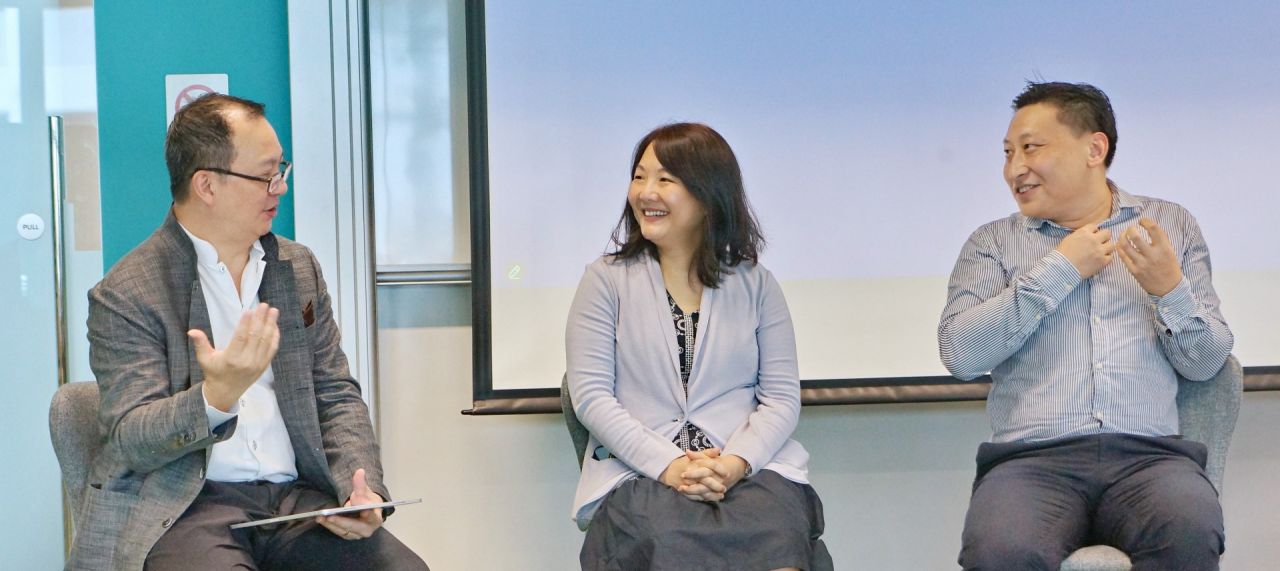
experience to C-Suite executives with decades of experience. A highlight of the event was a panel discussion moderated by Associate Provost (PGP Education) Associate Professor Themin Suwardy, featuring Associate Professor Mandy Tham and Assistant Professor Dai Bing Tian.
Themin kicked off the event with PGP updates, highlighting the upward trend in student enrollment and SMU’s aspirations to increase it by 50% in FY32. He also painted a picture of the current students’ demographic diversity in terms of age, experience, and nationality. When sharing the 2024 Student Experience Survey results, he took the opportunity to reveal some very encouraging feedback for PGP instructors: 90.2% are likely or very likely to recommend SMU PGP, and 93% are satisfied or very satisfied with the overall experience.
Building on the positive outlook, CTE presented trends showing a steady rise in course feedback ratings, with students affirming faculty strengths in preparation, organisation, and availability. Citing a recent ad-hoc, qualitative survey and focus group discussion conducted on the 2023 PGP intake, CTE briefly unpacked areas to strengthen, such as helping students see clearer connections between the overall learning experience and how it has helped them achieve learning outcomes.
Panel Discussion Key Takeaways
1. Customise Course Delivery to Experience Levels
When asked about what sets PGP teaching apart, both panellists raised the issue of diverse experience levels, and course delivery approaches that adapt accordingly. Mandy observed that pre-experience students like to start with definitions, formulas and frameworks as that is what one typically relies on in the absence of experience. In contrast, post-experience students require an instructor who can first tap into their need to learn something relevant to their profession.
“I don’t go in with the definition, math or theory,” said Mandy. “I go in with an example.” Using the story of Amazon’s acquisition of Whole Foods, attendees were treated to a live demo of how to get students interested in working capital optimisation.
Another issue both panellists raised was that PGP students tend to have greater difficulty remembering foundational concepts. In comparing various approaches experimented with in class, Bing Tian shared what he found most effective: quick refreshers on prerequisites embedded in course content and activities.
“Actually, they know the mathematical knowledge. It is somewhere in the corner of their brain," quipped Bing Tian. However, beyond mere recall, which is less critical at the postgraduate level, he suggested that it is more important to develop students' deeper intuition of the concepts and their ability to connect the dots.
Mandy also shared that her top tip for PGP teaching would be the ability to leverage collective wisdom in a class. In her post-experience classes, she observed that though the CFOs no longer handle the calculations themselves, they are good at interpreting the results. Other students in the class may be better at spotting errors planted in the spreadsheet. For Mandy, effective PGP teaching requires the instructor's ability to build bridges between students’ experiences. “I may not be the one with the highest IQ,” said Mandy. “But I must be the one with the highest EQ.”
2. Leverage the inclination to apply learning
Themin also raised participant questions on PGP approaches to assessment. In this regard, the panellists shared tips centred on PGP students’ inclination for application. “I give them more freedom,” shared Bing Tian. “They like to extend what they have learnt in class and learn a bit more.” Using mobile-friendly platforms like Piazza that support mathematical formulae, his MITB students raise questions, offer solutions and discuss examples beyond those used in class.
For Bing Tian’s PGP classes, assignment questions are based on extension examples discussed outside of class, rather than initial examples used in class. He challenges students to think critically about why previous experiences do not always apply. “It always depends on the situation. I want them to know there is a scope, a boundary to their experience.”
“UG students need to know what is on the exam, so they need a lot of numerical examples and guidance,” added Mandy. “For PGP students, there are a lot of case discussions.” Citing the case of MWM, an individual role-play with a real client and real assessor from industry was used in place of a traditional final exam. Exams, when used, are also highly scenario-based, requiring application rather than simple recall – what post-experience PGP students like.
Themin summed up the discussion by pointing out to attendees that differences exist between specialised and generalised programmes. For those focusing on students with a more specific, functional role, assessment formats like role-play can be particularly effective in drawing out the learning outcomes.
3. Focus on assessment design, not the mode
On the debate between final exam versus take-home assignments, both panellists suggested a nuanced focus on meaningfulness and fairness instead. “I don’t find that my PG students (necessarily) prefer take-home,” said Mandy. “At the end of the day, it is about having a balanced portfolio of assessments.” Students appreciate coursework that is balanced against the exam weightage to help “risk manage” the chances of failing because of an exam.
On this note, Themin added that in some disciplines, exams are unavoidable due to external accreditation requirements that specify everything from the number of multiple-choice questions to the type of questions used. For take-home assignments, he observed that it is more important to design the task well so that students find the learning meaningful.
While acknowledging the value of take-home exams, Bing Tian offered a different perspective, emphasising concerns about assessment integrity and fair grading. "Everyone knows that students use GPT. If they’re using it to write code, it can produce better code, but there's no reliable way to tell who actually wrote it," he cautioned. He also added that his students often prefer final exams, finding them less of a "drag" than take-home exams, which can become stressful over an extended period.
Additional points from Live Q&A
Themin noted that the international PGP landscape is getting increasingly competitive with the rising quality of higher education in traditional source countries. He shared that SMU PGP is working hard to build new pipelines, supported by the SMU Overseas Centres that engage local ecosystems. For now, Singapore remains attractive, especially as countries like Canada and Australia have imposed strict limits on international student admissions. Themin also responded to a related question on the core value propositions for SMU PGP programmes, highlighting five that apply across all programmes: global recognition, an innovative curriculum, interactive pedagogy, networking and career services, and a city campus. Additionally, he noted that each programme offers specialised value propositions tailored to its focus.